
WaveQuanta
High-power Annular Shaping DOE DOE25Q-1080-RI1-14
DOE25Q-1080-RI1-14
λ 1080.0nm
$3,236.10

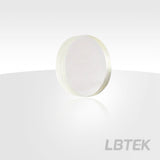
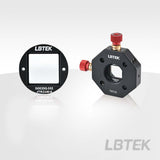
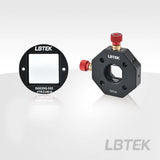
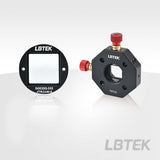
The AVR1-SNIR is a polymer achromatic vortex retarder that converts a conventional TEM00 Gaussian beam into a helical beam carrying orbital angular momentum (OAM) across the 700-1100 nm band. It imprints a topological charge of m = 1, producing a doughnut-shaped (hollow-core) intensity profile with an on-axis phase singularity. Under circularly polarized illumination it generates a vortex beam with l = ±1; under linearly polarized light it produces vector beams, including radially and azimuthally polarized states. Unlike single-wavelength spiral retarders, the achromatic design maintains vortex quality over a broad spectral range and is well suited to broadband and tunable sources.
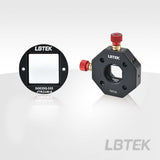
The retarder is built from three stacked layers of liquid-crystal polymer (LCP) on N-BK7 window substrates. Within each layer the molecular fast axis follows a continuous azimuthal gradient; the three layers are combined at designed angles so that the overall fast axis rotates by 180° over a full 360° azimuthal revolution, yielding a half-wave (λ/2) retardance and the spatially varying geometric phase that generates the vortex. The device delivers a visibility of >95% (white light), an OAM conversion efficiency of ≥98%, a transmitted wavefront error of <λ/4 at 633 nm, and a broadband anti-reflection coating (Ravg < 0.5% over 400-1100 nm). The 60/40 scratch-dig optic has a Ø21.5 mm clear aperture on a Ø25.4 x 2.3 mm element and is mounted in a 1-inch SM1-compatible mechanical sleeve. It accepts input beams from Ø0.5 to Ø21.5 mm at incidence angles within ±15°.
Operate and store at -20 to 80 °C in a dry, dust-free environment. Handle the optic by its mount and avoid touching the clear aperture; the liquid-crystal-polymer layers can be degraded by prolonged high-intensity or ultraviolet exposure and by mechanical contact. Use only recommended optical-cleaning procedures, and operate near normal incidence for best vortex quality.
| Component Size | Ø25.4x2.3 mm |
| Operating Wavelength | 700-1100 nm |
| Order m | 1 |
| Clear Aperture | Ø21.5 mm |
| Component Material | Liquid Crystal Polymer/N-BK7 Window Plate |
| Center Offset | <0.5 mm |
| Center Offset Error | <50 μm |
| Visibility | >95% (White Light) |
| Surface Quality (Scratch/Dig) | 60/40 |
| Transmittance | >94% |
| Retardance | λ/2 |
| Angle of Incidence (AOI) | ±15° |
| AR Coating | Ravg<0.5%@400-1100 nm |
| Input Beam Size | Ø0.5 to Ø21.5 mm |
| Housing Specification | SM1-8A Housing |
| Conversion Efficiency | ≥98% |
| Operating Temperature | -20 to 80 °C |
| Transmitted Wavefront Error | <λ/4@633 nm |


| Product | SKU | Optical Component Size | Operating Wavelength | Order m | |
|---|---|---|---|---|---|
| Polymer Achromatic Vortex Retarders AVR1-SNIR Current |
AVR1-SNIR
| Ø25.4x2.3 mm | 700-1100 nm | 1 | |
| Polymer Achromatic Vortex Retarders AVR1-VNIR |
AVR1-VNIR
| Ø25.4x2.3 mm | 600-800 nm | 1 | View |
| Polymer Achromatic Vortex Retarders AVR1-VIS |
AVR1-VIS
| Ø25.4x2.3 mm | 400-700 nm | 1 | View |