WaveQuanta
High-power Annular Shaping DOE DOE25Q-1080-RI1-14
DOE25Q-1080-RI1-14
λ 1080.0nm
$3,236.10
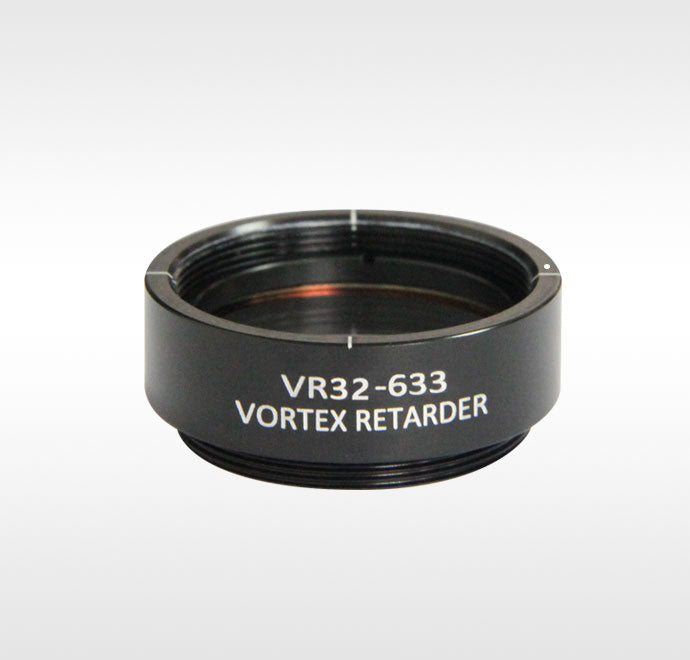
The VR32-532 is a polymer vortex retarder that converts a Gaussian beam into an optical vortex carrying orbital angular momentum with topological charge m = 32 at a design wavelength of 532 nm. A liquid-crystal-polymer layer is sandwiched between N-BK7 window plates: the fast axis rotates continuously in the azimuthal direction while the retardance stays uniform at λ/2 across the whole aperture, so the vortex is imposed by the geometric (Pancharatnam-Berry) phase rather than by any surface-relief microstructure.
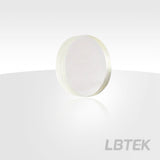
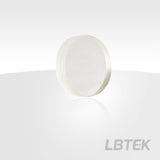
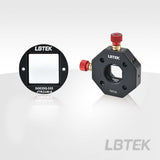
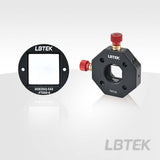
The element measures Ø25.4 x 3.2 mm with a Ø21.5 mm clear aperture and is supplied in an SM1-8A Housing mount. Transmittance at the working wavelength is >97% and the conversion efficiency into the target vortex mode is ≥99.5%; the anti-reflection coating is specified as Ravg<0.5% @400-700 nm. Wavefront error is <λ/4 @633 nm, surface quality 40/20, retardance accuracy ±5 nm and fast-axis accuracy ±1°. Accepted input beam diameters run from Ø0.3 to Ø21.5 mm, with the beam centred on the singularity to better than <0.5 mm.
Operate and store between -20 to 80°C in a dry, dust-free environment. The liquid-crystal-polymer layer is sealed between glass, but the coated surfaces should still be protected from abrasion; centre the beam on the vortex singularity and keep the element capped when it is not in use.
| Order m | 32 |
| Operating Wavelength | 532 nm |
| Component Size | Ø25.4 x 3.2 mm |
| Clear Aperture | Ø21.5 mm |
| Component Material | Liquid Crystal Polymer/N-BK7 Window Plate |
| Input Beam Size | Ø0.3 to Ø21.5 mm |
| Center Offset | <0.5 mm |
| Housing Specification | SM1-8A Housing |
| Wavefront Error (RMS) | <λ/4 @633 nm |
| AR Coating | Ravg<0.5% @400-700 nm |
| Retardance | λ/2 |
| Surface Quality (Scratch/Dig) | 40/20 |
| Delay Accuracy & Uniformity | ±5 nm |
| Operating Temperature | -20 to 80°C |
| Surface Parallelism | <1 arcmin |
| Transmittance (@working wavelength) | >97% |
| Conversion Efficiency | ≥99.5% |
| Fast Axis Accuracy (central angle) | ±1° |