WaveQuanta
Intense THz Spectroscopy System, Turnkey, > 10 MV/cm Peak Field
WQ-ITHZ-TK1Contact for pricing
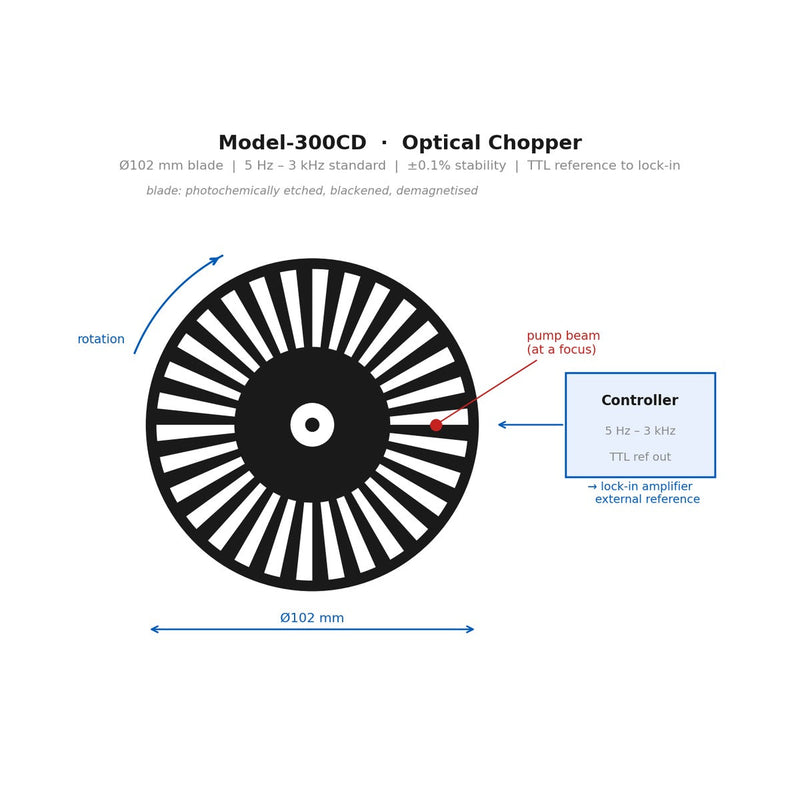
An optical chopper is a rotating slotted blade that periodically blocks a laser beam, converting a continuous signal into an amplitude-modulated one at a precisely known frequency. In a terahertz time-domain spectrometer the chopper sits in the pump arm and supplies the reference frequency that the lock-in amplifier demodulates against. This unit covers 5 Hz to 3 kHz as standard with a frequency stability of 0.1%, and can be extended from 15 mHz to 40 kHz with alternative blades.
The electro-optic sampling signal is a very small differential photocurrent riding on a large DC background, and it is buried in 1/f laser noise, mechanical drift and detector noise. Chopping the pump beam moves the terahertz-induced signal to a well-defined carrier frequency, and the lock-in amplifier then rejects everything outside a narrow band around that frequency. Choosing a chopping frequency that is not harmonically related to the mains frequency, and not close to any mechanical resonance of the table, typically buys 40 to 60 dB of dynamic range.
The 102 mm blade is photochemically etched rather than punched, so the slot edges are clean and the duty cycle is well defined; it is blackened to suppress back-reflection of the blocked pump beam into the beamline, and demagnetised so that it does not couple stray fields into nearby detectors. The open-frame head keeps the aperture accessible and lets the blade be positioned close to a beam waist, which minimises rise time and therefore modulation sidebands.
Place the chopper at or near a focus in the pump arm so the beam is fully blocked and fully passed in the shortest possible time. Feed the TTL reference output to the lock-in amplifier external reference input. Note that the chopper head, not the controller, is the element that occupies space on the optical table and must be included in the mechanical layout; the controller is normally rack- or shelf-mounted off the table.
| Model | Model-300CD |
| Type | Open-frame optical chopper system |
| Standard frequency range | 5 Hz - 3 kHz |
| Extended frequency range | 15 mHz - 40 kHz (with matching blades) |
| Frequency stability | +/- 0.1% |
| Chopper blade diameter | 102 mm |
| Blade treatment | Photochemically etched and blackened, demagnetised |
| Reference output | TTL synchronisation output for lock-in amplifier |
| Mounting | Post-mountable head, separate controller |
| Typical THz-TDS chopping frequency | 0.5 - 2 kHz on the pump arm |
| Product | SKU | Size | Clear Aperture | Operating Wavelength | |
|---|---|---|---|---|---|
| Intense THz Spectroscopy System, Turnkey, > 10 MV/cm Peak Field |
WQ-ITHZ-TK1
| — | — | — | Contact |
| Tera-Bullet Intense THz Spectrometer |
SWT-TERABULLET
| — | — | — | Contact |
| PCA Scanner THz Imaging Spectrometer, Portable, > 5 THz |
SWT-PCA-SCANNER
| — | — | — | Contact |
| High Voltage Modulator HVM for Photoconductive Antennas |
SWT-HVM
| — | — | — | Contact |
| Fiber-Coupled Optical Delay Line ODL, 5 fs Resolution, up to 50 ns Range |
SWT-ODL
| — | — | — | Contact |
| Optical Chopper, 5 Hz - 3 kHz, 102 mm Blade, Lock-in Reference Source Current |
WQ-THZ-CHOPPER-300CD
| — | — | — |