WaveQuanta
Request Quote
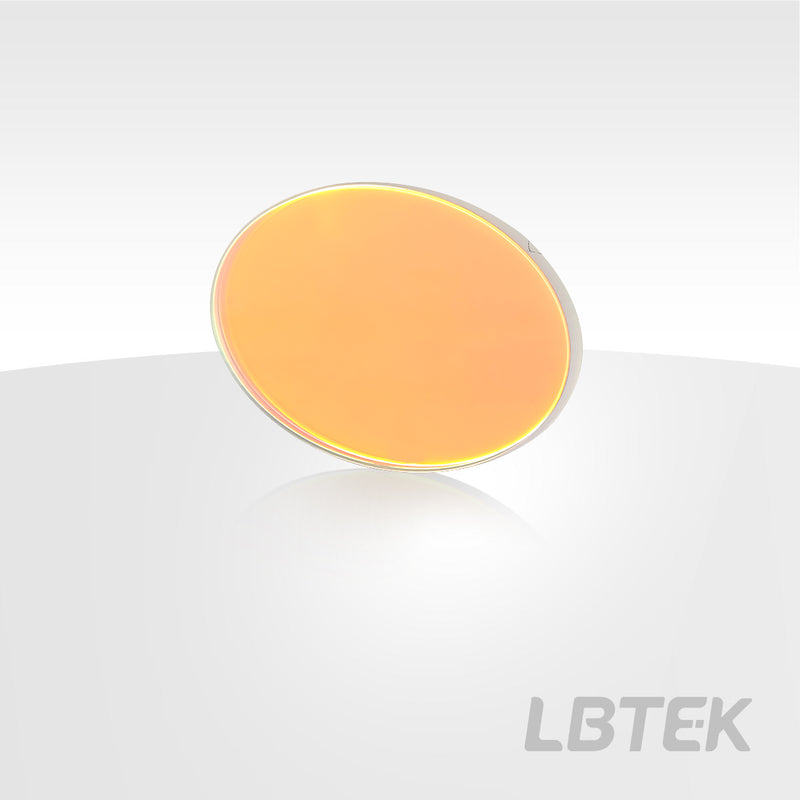
Short-pass dichroic mirror, elliptical DME38×57-550SP-SP
DME38×57-550SP-SP$690.78
In Stock
Key Specifications
Reflectance
0.2%
Design Tools
View all 49 calculators →RoHS
REACH
Short-pass dichroic mirror, elliptical — Model DME38×57-550SP-SP
Substrate UV Fused Silica.
Product Description
- Substrate Material: UV Fused Silica
- Four sizes available: Ø12.7 mm, Ø25.4 mm, Ø50.8 mm, and 36.0 mm × 25.0 mm
- Application: filtering and beam splitting
LBTEK Shortpass Dichroic Mirrors can separate light beams based on wavelength. Shortpass dichroic mirrors transmit light beams below the cut-off wavelength while reflecting those above the cut-off wavelength with high transmission and high reflection characteristics. Our dichroic mirrors offer 14 cut-off wavelength options: 425 nm, 490 nm, 505 nm, 550 nm, 605 nm, 638 nm, 650 nm, 780 nm, 805 nm, 950 nm, 1000 nm, 1180 nm, 1500 nm, and 1800 nm, with average transmission and reflection rates exceeding 90% within the specified wavelength ranges. LBTEK provides four size options: Ø12.7 mm, Ø25.4 mm, Ø50.8 mm, and 36.0 mm × 25.0 mm. A dichroic mirror has a filter coating on one surface and an antireflection coating on the other. The arrow points to the filter-coated surface. LBTEK also offers longpass dichroic mirrors, which transmit light above the cut-on wavelength while reflecting light below it. In addition to standard dichroic mirrors, LBTEK also offers a variety of custom dichroic mirrors. Please contact LBTEK Technical Support for special requirements.
Short-pass dichroic mirror, elliptical
- Substrate Material: UVFS
- Elliptical
- Application: Filtering and Beam Splitting
LBTEK dichroic mirrors can separate light beams based on wavelength. Shortpass dichroic mirrors transmit light beams below the cutoff wavelength while reflecting those above it, featuring high transmission and high reflection characteristics. Currently, the elliptical dichroic mirror has a cutoff wavelength of 550 nm, achieving over 90% transmittance in the specified band range (390-533 nm) and over 90% reflectance in the range (565-800 nm). One surface of the dichroic mirror is coated with a filter film, and the other side is coated with an anti-reflection film. It is recommended to have the light incident from the filter film side (the side arrow points to the filter film-coated surface).
| Material | UV Fused Silica |
| Clear Aperture | >90% CA |
| Thickness | 3.0 mm |
| Thickness Tolerance | +0.0/-0.1 mm |
| Reflectivity | Rabsb <0.2% @ 532 nm |
| Start (Stop) Wavelength | 550 nm |
| Passband | 390 nm-533 nm(Tabs > 95%) |
| Reflection Band | 565 nm-800 nm(Rabs > 90%) |
| Surface Quality (Scratch/Dig) | 80/50 |
| Transmitted Wavefront Error (TWE) (@633 nm) | λ/2 |
| Parallelism | <3 arcmin |
| Angle of Incidence (AOI) | 45° |
| Dimensional specifications | Major Axis 56.6 mm,Minor Axis 37.6 mm |
CAD Drawing
Download
Click and drag to rotate. Scroll to zoom.

Transmission and Reflectance Spectral Curves of 425SP,45°AOI

Transmission and Reflectance Spectral Curves of 490SP,45°AOI

Transmission and Reflectance Spectral Curves of 505SP,45°AOI

Transmission and Reflectance Spectral Curves of 550SP,45°AOI

Transmission and Reflectance Spectral Curves of 605SP,45°AOI

Transmission and Reflectance Spectral Curves of 638SP,45°AOI

Transmission and Reflectance Spectral Curves of 650SP,45°AOI

Transmission and Reflectance Spectral Curves of 780SP,45°AOI

Transmission and Reflectance Spectral Curves of 805SP,45°AOI

Transmission and Reflectance Spectral Curves of 950SP,45°AOI

Transmission and Reflectance Spectral Curves of DM05_20_R-1000SP,45°AOI

Transmission and Reflectance Spectral Curves of 1180SP,45°AOI

Transmission and Reflectance Spectral Curves of 1500SP,45°AOI

Transmission and Reflectance Spectral Curves of 1800SP,45°AOI

Transmission and Reflectance Spectral Curves of DMR-680SP-SP,45°AOI


WaveQuanta
Metal Plane Mirrors, Silver Coating: 480 nm-20.0 μm, Rectangular PMR10-AG
PMR10-AG
λ 480.0nm
$112.31


WaveQuanta
Elliptical Reflectors, Aluminum Coating: 450 nm-20.0 μm PM05E-AL
PM05E-AL
λ 450.0nm
$77.91

WaveQuanta
Elliptical Reflectors, Aluminum Coating: 450 nm-20.0 μm PM10E-AL
PM10E-AL
λ 450.0nm
$107.85