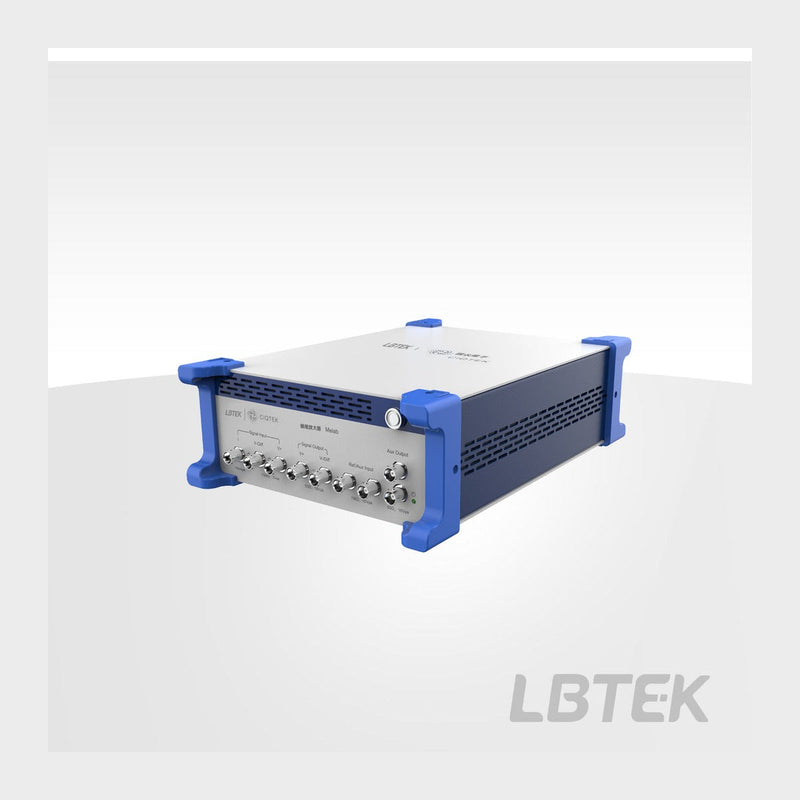
Digital Lock-in Amplifier Melab
MelabDesign Tools
Complete Your Setup
Overview
A lock-in amplifier recovers a small signal buried in noise by multiplying the input by a reference waveform and low-pass filtering the product. Only components of the input that are coherent with the reference in both frequency and phase survive; everything else averages to zero. This instrument covers DC to 1 MHz, samples at 100 MSa/s and has an input voltage noise density below 2.4 nV per root hertz above 1 kHz.
Role in THz time-domain spectroscopy
The chopper modulates the pump arm at a known frequency and supplies a TTL reference. The balanced photodetector output goes to the lock-in signal input. At each position of the delay line the lock-in returns the demodulated amplitude, which is proportional to the terahertz field at that particular delay. Stepping the delay line and recording the lock-in output therefore builds up the terahertz field waveform point by point, and a Fourier transform converts it into a broadband amplitude and phase spectrum.
Choosing the time constant
The lock-in time constant sets the trade between noise rejection and scan speed. A longer time constant narrows the detection bandwidth and improves signal to noise, but the delay line must then dwell longer at each point. As a practical rule, allow at least five time constants of settling after each delay step before recording, and verify the choice by confirming that a repeat scan reproduces the waveform. A dynamic range of 40 to 60 dB is routinely achievable in a well-purged setup.
Expansion and synchronisation
The instrument can be expanded to four demodulators, which allows simultaneous measurement at several harmonics of the chopping frequency or simultaneous monitoring of a reference channel. External 10 or 100 MHz clock input and output allow multiple instruments to share a common timebase, which matters when a delay stage controller, a data acquisition card and the lock-in must stay in step over a long scan. Optional PID functionality can be used to stabilise beam pointing or power in the pump arm.
| Type | Digital lock-in amplifier |
| Frequency range | DC - 1 MHz (5 MHz with option) |
| Sampling rate | 100 MSa/s |
| Demodulators | 1 standard, expandable to 4 with multi-demodulator option |
| Input voltage noise density | < 2.4 nV/sqrt(Hz) above 1 kHz |
| Input range | -3 V to +3 V |
| Reference clock input | External 10 / 100 MHz |
| Reference clock output | 10 / 100 MHz |
| Signal inputs | 1 voltage / current input plus 4 auxiliary inputs |
| Signal outputs | 1 voltage output plus 4 auxiliary outputs |
| Trigger channels | 2 |
| Optional functions | PID controller, AM-FM modulation, impedance analysis |
| Dimensions | 322 x 229 x 97 mm |
| Power consumption | < 60 W |