WaveQuanta
Intense THz Spectroscopy System, Turnkey, > 10 MV/cm Peak Field
WQ-ITHZ-TK1Contact for pricing
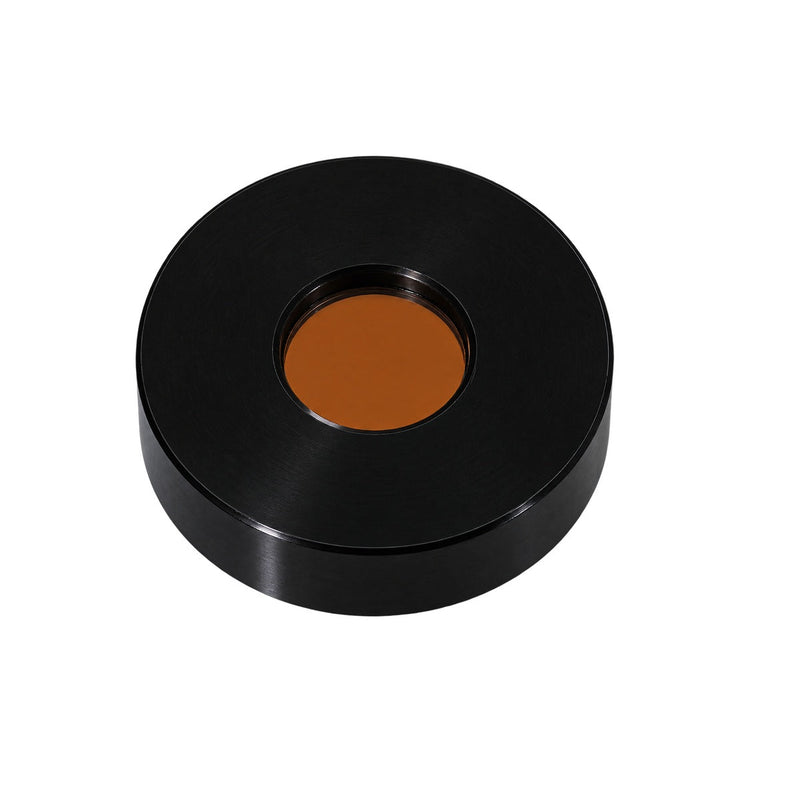
GaP is the workhorse electro-optic crystal for Yb-driven terahertz time-domain spectroscopy. Near 1 um the optical group index and the terahertz phase index in GaP are almost equal, so velocity matching is satisfied in the simplest possible collinear geometry with no tilted pulse front, no grating imaging and no wavelength conversion. This is the single most important reason why GaP is recommended as the first crystal for anyone building a standard terahertz time-domain spectrometer around a 1030 nm femtosecond source.
The terahertz electric field induces a transient birefringence in the (110)-cut crystal via the Pockels effect. A co-propagating femtosecond probe pulse therefore acquires a small polarisation rotation proportional to the instantaneous terahertz field. A quarter-wave plate biases the probe to circular polarisation, a Wollaston prism splits it into two orthogonal components, and a balanced photodetector measures the difference. Scanning the probe delay reconstructs the full terahertz field waveform in the time domain; a Fourier transform then gives amplitude and phase spectra simultaneously, which is what allows direct extraction of the complex refractive index of a sample.
Crystal thickness sets a direct trade between sensitivity and bandwidth. A thicker crystal gives a longer interaction length and therefore a larger signal, but the velocity match holds over a narrower frequency range, so high-frequency components wash out and the detected spectrum is truncated. The 0.3 mm thickness supplied here is a practical compromise for standard time-domain spectroscopy; use 0.1 mm when the priority is bandwidth beyond about 4 THz, and 0.5 to 1 mm when the same material is used as an emitter.
Both the terahertz beam and the probe beam must be focused onto the same spot on the crystal, with the terahertz spot larger than the probe spot so the probe samples a uniform field. The (110) orientation is not rotationally symmetric: rotate the crystal about the beam axis to maximise the differential signal before optimising anything else. Keep the crystal in a purged enclosure together with the rest of the terahertz path, since water vapour absorption lines will otherwise dominate the measured spectrum.
| Material | Gallium phosphide (GaP) |
| Orientation | (110) cut |
| Aperture | 10 x 10 mm, square |
| Thickness | 0.3 mm |
| Function | Electro-optic sampling detection; also usable for THz generation |
| Matched pump wavelength | approx. 1030 nm (native velocity match for Yb) |
| THz detection bandwidth | approx. 0.1 - 7 THz (thickness dependent) |
| Typical detection thickness | 0.1 - 0.3 mm |
| Typical emission thickness | 0.3 - 1 mm |
| Detection scheme | quarter-wave plate + Wollaston prism + balanced photodetector |
| Transparency | Transparent from approx. 0.55 um into the mid-infrared |
| Refractive index behaviour | n_opt approximately equal to n_THz near 1 um |