WaveQuanta
TrueChrome PDAF Autofocus HDMI Microscope Camera, 50 fps, USB 2.0
TrueChrome PDAFContact for pricing
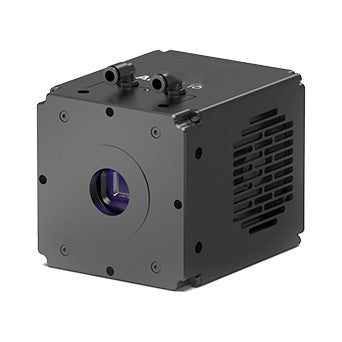
A large-pixel sCMOS camera for photon-starved imaging, from single molecules to cold atoms.
The Aries 16 LT is a back-illuminated sCMOS camera with 16 µm pixels on an 800 × 600 sensor, built for measurements where only a few photons reach each pixel. It reaches 0.9 e⁻ read noise in Low Noise mode and holds a typical 73 ke⁻ full well, so it can take the place of an EMCCD camera without excess-noise or gain-aging issues. Air or liquid cooling, USB 3.0 and CameraLink outputs and a C-mount make it easy to fit into existing optical setups.
Browse all: sCMOS Cameras · Cameras
Model: Aries 16 LT · Acquisition software and drivers are supplied with the camera. Contact WaveQuanta for a quote and lead time.
| Sensor Type | BSI sCMOS |
| Color / Mono | Mono |
| Peak QE | 90.7% @ 550 nm |
| Resolution | 800 × 600 |
| Pixel Size | 16 µm × 16 µm |
| Effective Area | 12.8 mm × 9.6 mm |
| Array Diagonal | 16 mm |
| Full-Well Capacity | 73 ke⁻ (typical) |
| Readout Noise | 0.9 e⁻ (Low Noise mode); 1.6 e⁻ (HDR mode), typical |
| Dynamic Range | 93 dB (typical) |
| Frame Rate | 60 fps (HDR mode); 25 fps (Low Noise mode) |
| Shutter Type | Rolling, global reset |
| Exposure Time | 26 µs – 60 s |
| Binning | 2 × 2, 4 × 4, arbitrary binning |
| ROI | Supported |
| Cooling Method | Air, liquid |
| Cooling Temperature | Air: 50 °C below ambient; liquid: 60 °C below ambient |
| Dark Current | 0.2 e⁻/pixel/s |
| DSNU / PRNU | 0.3 e⁻ / 0.3% |
| Bit Depth | 12 bit, 16 bit |
| Data Interface | USB 3.0, CameraLink |
| Trigger | Hardware, software; SMA connectors |
| Trigger Output | Exposure Start, Global Exposure, Readout End, High, Low |
| Timestamp | 1 µs accuracy |
| Optical Interface | C-mount |
| Power Supply | 12 V / 8 A |
| Power Consumption | 38 W |
| Dimensions | 95 mm × 95 mm × 114 mm (H × W × L) |
| Weight | 1500 g |
| Operating Environment | Working 0–40 °C, 0–85% RH; storage 0–60 °C, 0–90% RH |
| Operating System | Windows, Linux |
| Software / SDK Support | Acquisition and analysis software, LabVIEW, MATLAB, Micro-Manager 2.0; C/C++/C#/Python SDK |