WaveQuanta
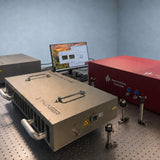
Intense THz Spectroscopy System, Turnkey, > 10 MV/cm Peak Field
WQ-ITHZ-TK1Contact for pricing
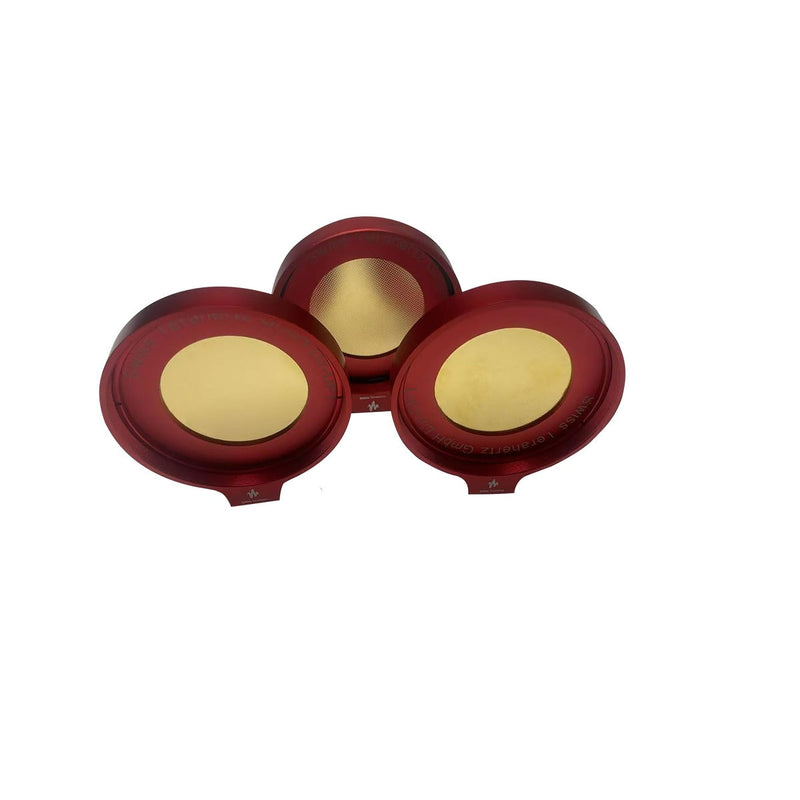
A terahertz filter set is what turns a broadband source into a controlled measurement. These filters cover bandpass, bandstop, low pass and high pass forms with peak transmission typically above 90%, central frequency held to better than 5% as standard and to better than 1% on request, and apertures up to 150 mm for large-beam work.
Broadband terahertz sources emit across several octaves, and detectors respond across much of that range. Without filtering, a measurement at one frequency is contaminated by everything else the source produces, and water-vapour absorption lines elsewhere in the spectrum show up as unexplained structure. Selecting a band before the detector removes that ambiguity and usually improves signal to noise at the same time, because out-of-band power that only contributes noise is rejected.
Bandpass filters isolate a frequency of interest and are the usual starting point for imaging and for narrowband sensing. Bandstop filters remove a specific unwanted line, for example a strong source artefact. Low pass filters are the standard way to reject the high-frequency tail and any residual near-infrared leakage, and high pass filters do the reverse. Where rejection outside the band is critical rather than merely useful, the high-rejection bandpass type is the correct choice.
Central frequency and bandwidth are both customisable, so specify the physical quantity the experiment needs rather than picking from a catalogue grid. State the required aperture together with the beam diameter at the filter position: filters are often placed at a collimated section where the beam is much larger than at the focus, and an undersized filter will clip the beam and distort the measured spectrum.
| Types | Bandpass (BP), bandstop (BS), low pass (LP), high pass (HP) |
| Peak transmission | > 70%, typically > 90% |
| Central frequency tolerance | < 5%, customisable to < 1% |
| Bandwidth | < 30%, customisable to < 1% |
| Maximum size | Up to 150 mm |
| Standard bandpass range | < 3 THz (Type 1) |
| Extended bandpass range | 3 - 30 THz (Type 2) |
| High rejection option | Type 3 high-rejection bandpass |
| Standard low pass | Type 4 |
| Availability | Contact for centre frequency, bandwidth and aperture |
| Product | SKU | Size | Clear Aperture | Operating Wavelength | |
|---|---|---|---|---|---|
| 90 deg Off-Axis Parabolic Mirror, Through Hole Parallel to the Collimated Beam, 2", RFL 152.4 mm, Protected Gold |
WQ-THZ-OAP2612-V
| — | — | — | Contact |
| THz Imaging Objective Lens, 0.1 - 30 THz |
SWT-OBJ
| — | — | — | Contact |
| High-Resistivity Silicon THz Windows |
SWT-WIN-SI
| — | — | — | Contact |
| TPX THz Windows |
SWT-WIN-TPX
| — | — | — | Contact |
| TPX THz Lens |
SWT-LENS-TPX
| — | — | — | Contact |
| HDPE THz Lens |
SWT-LENS-HDPE
| — | — | — | Contact |
| THz Filters: Bandpass, Bandstop, Low Pass and High Pass Current |
SWT-FILTER
| — | — | — | |
| 90 deg Off-Axis Parabolic Mirror, Through Hole Parallel to the Focused Beam, 2", RFL 152.4 mm, Protected Gold |
WQ-THZ-OAP2612-H
| — | — | — | Contact |
| TPX Plano-Convex THz Lens TLA25050, 25.4 mm Diameter, 50 mm Focal Length |
WQ-THZ-LENS-TLA25050
| — | — | — | Contact |