WaveQuanta
Intense THz Spectroscopy System, Turnkey, > 10 MV/cm Peak Field
WQ-ITHZ-TK1Contact for pricing
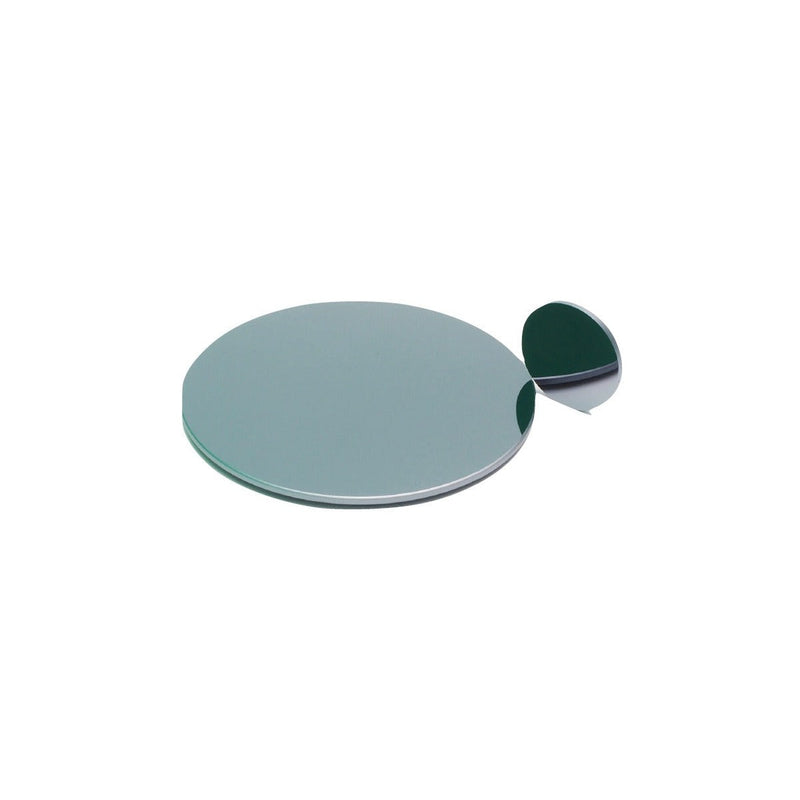
High-resistivity silicon has the flattest refractive index and among the lowest absorption of any terahertz window material, which makes it the reference choice where optical performance and mechanical strength both matter. These windows are finished to 80/50 scratch-dig with diameter held to 0.2 mm and curvature to 0.01 mm.
Silicon is rigid enough to hold a pressure differential, so it is the standard window for vacuum chambers and cryostats, where a polymer window would flex or fail. It is also the usual material for terahertz beam combiners, because a thin silicon plate can transmit a near-infrared probe while reflecting the terahertz beam, or the reverse, depending on geometry.
The refractive index of about 3.42 is high, so roughly 30% of the incident power is reflected at each uncoated surface and the internal etalon is strong. In a time-domain measurement this shows up as a clear delayed replica of the main pulse. Either specify the thickness so the replica falls outside the scan window, use a wedged part so the internal reflections walk off axis, or ask about anti-reflection treatment.
Silicon is opaque in the visible, so a visible alignment laser cannot be used through it; set the axis first with a TPX part or align mechanically. Handle by the edge and keep the faces clean, since surface contamination shows up more strongly in a high-index material. For any window in the terahertz path, state the beam diameter at that plane along with the aperture you need, so the part is not undersized in a collimated section.
| Material | High-resistivity silicon |
| Surface quality | 80/50 scratch-dig |
| Curvature tolerance | +/- 0.01 mm |
| Diameter tolerance | +/- 0.2 mm |
| Refractive index | approx. 3.42, nearly flat across the THz band |
| Absorption | Very low across the THz band |
| Visible transmission | Opaque in the visible |
| Mechanical | Rigid, suitable for vacuum windows |
| Typical use | Vacuum and cryostat windows, beam combiners, detector windows |
| Availability | Contact for size, thickness and coating |

| Product | SKU | Size | Clear Aperture | Operating Wavelength | |
|---|---|---|---|---|---|
| 90 deg Off-Axis Parabolic Mirror, Through Hole Parallel to the Collimated Beam, 2", RFL 152.4 mm, Protected Gold |
WQ-THZ-OAP2612-V
| — | — | — | Contact |
| THz Imaging Objective Lens, 0.1 - 30 THz |
SWT-OBJ
| — | — | — | Contact |
| High-Resistivity Silicon THz Windows Current |
SWT-WIN-SI
| — | — | — | |
| TPX THz Windows |
SWT-WIN-TPX
| — | — | — | Contact |
| TPX THz Lens |
SWT-LENS-TPX
| — | — | — | Contact |
| HDPE THz Lens |
SWT-LENS-HDPE
| — | — | — | Contact |
| THz Filters: Bandpass, Bandstop, Low Pass and High Pass |
SWT-FILTER
| — | — | — | Contact |
| 90 deg Off-Axis Parabolic Mirror, Through Hole Parallel to the Focused Beam, 2", RFL 152.4 mm, Protected Gold |
WQ-THZ-OAP2612-H
| — | — | — | Contact |
| TPX Plano-Convex THz Lens TLA25050, 25.4 mm Diameter, 50 mm Focal Length |
WQ-THZ-LENS-TLA25050
| — | — | — | Contact |