
WaveQuanta
Intense THz Spectroscopy System, Turnkey, > 10 MV/cm Peak Field
WQ-ITHZ-TK1Contact for pricing
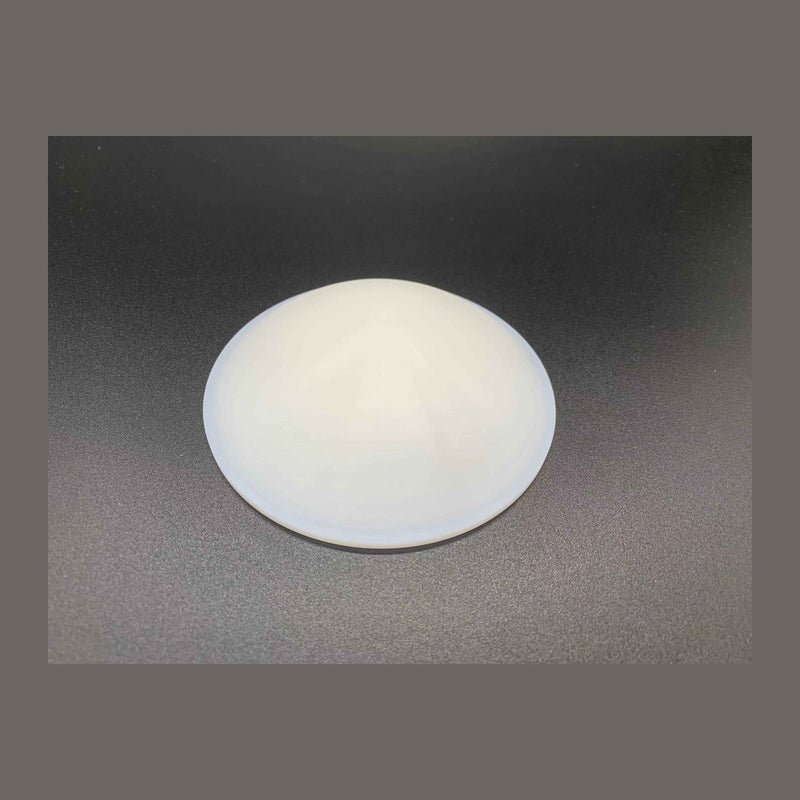
HDPE is one of the two standard polymer lens materials for the terahertz band. It is inexpensive, low loss across a wide frequency range, easy to machine into large apertures, and mechanically forgiving. These lenses are made to 80/50 scratch-dig with curvature held to 0.01 mm and diameter to 0.2 mm.
The two materials behave similarly in the terahertz band, and the choice usually comes down to two practical differences. TPX is transparent in the visible, so an alignment laser passes straight through it and the optical axis can be set before any terahertz is generated. HDPE is not, so alignment has to be done mechanically or with the terahertz beam itself. Against that, HDPE is cheaper and scales to large apertures more easily, which matters when the lens sits in a collimated section of a big beam.
Gold off-axis parabolic mirrors remain the first choice for a terahertz beamline because they are perfectly achromatic and add no material absorption. A lens is far more compact and needs only two alignment degrees of freedom instead of four or five, so it wins wherever the layout is tight, the terahertz path is short, or the lens also has to serve as a chamber window.
Orient the convex face toward the collimated side to minimise spherical aberration. Fresnel reflection at each polymer surface is a few percent and can produce a delayed etalon replica in the time-domain trace; if that replica lands inside the scan window, either extend the scan so it can be windowed out or tilt the lens slightly. Keep the lens inside the purged volume along with the rest of the terahertz path.
| Material | HDPE (high-density polyethylene) |
| Surface quality | 80/50 scratch-dig |
| Curvature tolerance | +/- 0.01 mm |
| Diameter tolerance | +/- 0.2 mm |
| Transmission | Low absorption across the THz band |
| Dispersion | Low across the THz band |
| Visible transmission | Opaque / translucent in the visible |
| Forms | Plano-convex and custom geometries |
| Typical use | THz beam focusing and collimation |
| Availability | Contact for diameter, focal length and quantity |

| Product | SKU | Size | Clear Aperture | Operating Wavelength | |
|---|---|---|---|---|---|
| 90 deg Off-Axis Parabolic Mirror, Through Hole Parallel to the Collimated Beam, 2", RFL 152.4 mm, Protected Gold |
WQ-THZ-OAP2612-V
| — | — | — | Contact |
| THz Imaging Objective Lens, 0.1 - 30 THz |
SWT-OBJ
| — | — | — | Contact |
| High-Resistivity Silicon THz Windows |
SWT-WIN-SI
| — | — | — | Contact |
| TPX THz Windows |
SWT-WIN-TPX
| — | — | — | Contact |
| TPX THz Lens |
SWT-LENS-TPX
| — | — | — | Contact |
| HDPE THz Lens Current |
SWT-LENS-HDPE
| — | — | — | |
| THz Filters: Bandpass, Bandstop, Low Pass and High Pass |
SWT-FILTER
| — | — | — | Contact |
| 90 deg Off-Axis Parabolic Mirror, Through Hole Parallel to the Focused Beam, 2", RFL 152.4 mm, Protected Gold |
WQ-THZ-OAP2612-H
| — | — | — | Contact |
| TPX Plano-Convex THz Lens TLA25050, 25.4 mm Diameter, 50 mm Focal Length |
WQ-THZ-LENS-TLA25050
| — | — | — | Contact |