WaveQuanta
Intense THz Spectroscopy System, Turnkey, > 10 MV/cm Peak Field
WQ-ITHZ-TK1Contact for pricing
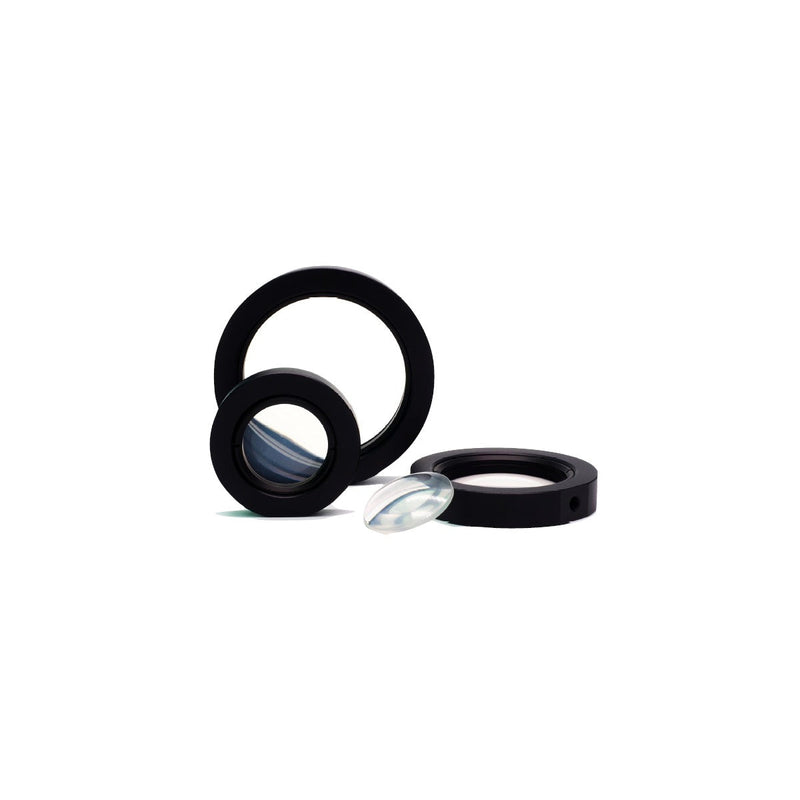
TPX, or polymethylpentene, combines low absorption with a refractive index that stays almost flat across the whole terahertz band. That near-zero dispersion is what makes it usable with single-cycle terahertz pulses, where a dispersive material would stretch the pulse and destroy the time-domain waveform. These lenses are finished to 80/50 scratch-dig with curvature held to 0.01 mm.
TPX is transparent in the visible. A HeNe or diode alignment laser passes straight through the lens, so the optical axis, beam height and focus position can all be set before any terahertz radiation exists. High-resistivity float-zone silicon, the other common terahertz lens material, is opaque in the visible and does not allow this. On a first build that difference alone can save a day.
Off-axis parabolic mirrors are achromatic and lossless in the terahertz band and remain the default for a research beamline. A TPX lens is the pragmatic choice for compact instruments, for a sample-chamber window that also has to focus, and for any stage where the terahertz path is short enough that dispersion and absorption are not the limiting factors. TPX is also light and easily machined, which keeps mount loading low.
Orient the convex face toward the collimated side. With an index near 1.46 the Fresnel reflection at each surface is a few percent, which can create a delayed etalon replica in the time-domain trace; extend the scan range so the replica can be windowed out, or tilt the lens slightly. Keep the lens inside the purged enclosure with the rest of the terahertz path so that water-vapour lines do not appear in the spectrum.
| Material | TPX (polymethylpentene) |
| Surface quality | 80/50 scratch-dig |
| Curvature tolerance | +/- 0.01 mm |
| Diameter tolerance | +/- 0.2 mm |
| Dispersion | Near-zero across the THz band |
| Visible transmission | Transparent, allows alignment with a visible laser |
| Refractive index | approx. 1.46 in the THz band |
| Forms | Plano-convex and custom geometries |
| Typical use | THz beam focusing and collimation, chamber windows |
| Availability | Contact for diameter, focal length and quantity |

| Product | SKU | Size | Clear Aperture | Operating Wavelength | |
|---|---|---|---|---|---|
| 90 deg Off-Axis Parabolic Mirror, Through Hole Parallel to the Collimated Beam, 2", RFL 152.4 mm, Protected Gold |
WQ-THZ-OAP2612-V
| — | — | — | Contact |
| THz Imaging Objective Lens, 0.1 - 30 THz |
SWT-OBJ
| — | — | — | Contact |
| High-Resistivity Silicon THz Windows |
SWT-WIN-SI
| — | — | — | Contact |
| TPX THz Windows |
SWT-WIN-TPX
| — | — | — | Contact |
| TPX THz Lens Current |
SWT-LENS-TPX
| — | — | — | |
| HDPE THz Lens |
SWT-LENS-HDPE
| — | — | — | Contact |
| THz Filters: Bandpass, Bandstop, Low Pass and High Pass |
SWT-FILTER
| — | — | — | Contact |
| 90 deg Off-Axis Parabolic Mirror, Through Hole Parallel to the Focused Beam, 2", RFL 152.4 mm, Protected Gold |
WQ-THZ-OAP2612-H
| — | — | — | Contact |
| TPX Plano-Convex THz Lens TLA25050, 25.4 mm Diameter, 50 mm Focal Length |
WQ-THZ-LENS-TLA25050
| — | — | — | Contact |