WaveQuanta
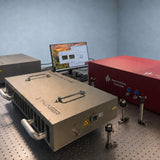
Intense THz Spectroscopy System, Turnkey, > 10 MV/cm Peak Field
WQ-ITHZ-TK1Contact for pricing

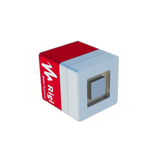
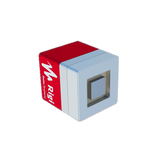
DAST is the longest-established of the high-performance organic terahertz crystals and still one of the broadest-band emitters available. Its second-order nonlinear coefficient is far above that of inorganic electro-optic materials such as ZnTe or GaP, which is what allows it to reach very high peak terahertz fields while covering a spectral range that extends well past 10 THz. It works as a generator by optical rectification and equally as a detector by electro-optic sampling.
DAST is phase matched for pump wavelengths around 1.3 to 1.5 um, so it is normally driven by an optical parametric amplifier, an OPCPA, or a telecom-band fibre source rather than directly by an Yb or Ti:Sapphire oscillator. That extra conversion stage is the price of admission; what you get back is spectral coverage from roughly 0.1 to 17 THz, which no inorganic emitter approaches. If your pump is fixed at 800 or 1030 nm, BNA is the more practical choice.
The two crystals are chemically close and optically similar. DSTMS converts slightly more efficiently into the terahertz band, while DAST tends to produce a broader spectrum and therefore a higher achievable peak electric field, and it tolerates a higher damage threshold. In practice the choice comes down to whether the experiment is limited by bandwidth or by conversion efficiency, and many groups keep both on hand.
Organic terahertz crystals are soft, hygroscopic and easily damaged. Store them sealed and dry, keep the mounted element inside a nitrogen or dry-air purge box during operation, and raise the pump fluence gradually while watching the terahertz signal rather than jumping straight to the target level. Never clean the crystal face with solvents, and always handle the part by its mount or substrate edge. Damage in organic crystals is usually cumulative rather than catastrophic, so a crystal that has been overdriven once will keep degrading.
| Crystal | DAST (4-N,N-dimethylamino-4'-N'-methyl stilbazolium tosylate) |
| Function | THz generation and detection, multi-THz generation, second harmonic generation |
| Pump wavelength | approx. 1.3 - 1.5 um |
| THz bandwidth | 0.1 - 17 THz |
| Typical pump sources | OPA, OPCPA, telecom fibre laser |
| Damage threshold | Higher than DSTMS |
| Spectral character | Broader spectrum than DSTMS, higher achievable peak field |
| Maximum aperture | Up to 65 mm |
| Warranty | 1 year |
| Availability | Contact for lead time and aperture options |