UltraFast Innovations
TUNDRA® — Ultra-High Contrast Third-Order Autocorrelator (up to 10¹⁴ Dynamic Range)
Contact for pricing
Contact Sales
Design Tools
Time-Bandwidth Product
Check if your pulse is transform-limited
Pulse Stretching & Compression
Calculate GVD, TOD, and pulse broadening
View all 49 calculators →
RoHS
REACH
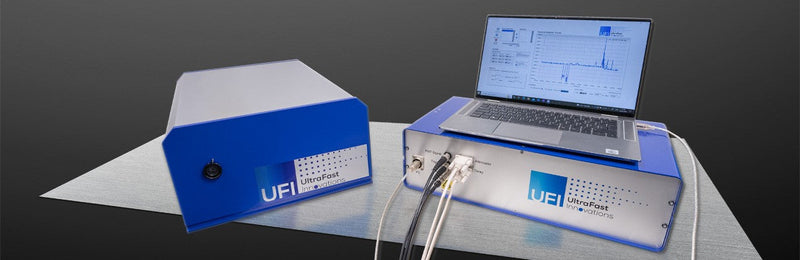
The TUNDRA® third-order autocorrelator is a highly sensitive diagnostic tool for laser pulse contrast measurements. After further development, the dynamic range reaches up to 14 orders of magnitude — sufficient to characterize the background and detect even the tiniest pre- and post-pulse replicas of the most powerful lasers in the world.
The autocorrelator employs all-reflective components, guaranteeing correlation traces free of measurement artefacts. In contrast to second-order autocorrelators, pre- and post-pulses can be distinguished due to the third-harmonic nature of the signal. These features make our specialized fully-automated autocorrelator an invaluable tool for state-of-the-art contrast characterization of ultrashort and intense laser pulses.
TUNDRA has been used to characterize some of the most powerful and unique terawatt- and petawatt-class laser systems in the world, including ATLAS (Garching, 50-250 TW), PFS (MPQ, 100 TW), SYLOS (ELI-ALPS), APOLLON (Palaiseau, up to 5 PW), PHELIX (GSI, 500 TW), and SALLE JAUNE (LOA, 200 TW).
Key Product Features
- Ultra-sensitive pulse contrast measurement
- Three dynamic-range tiers: 10¹¹ (TUNDRA), 10¹² (TUNDRA+), up to 10¹⁴ (TUNDRA++)
- Up to 3.8 ns scan range — capture pre- and post-pulses across long delays
- No ghost pulse artefacts (all-reflective design)
- Easy to set up and use — fully automated
- Full user-friendly software package
- Customizable for laser specifications
Available Laser Types
- Ti:Sa — 800 nm
- Cr³⁺-based: 690-850 nm (e.g., ruby, alexandrite, colquiriite lasers)
- Nd-based: 1053-1064 nm (e.g., Nd:YAG, Nd:YLF, Nd:Glass)
- Yb-based: 1007-1079 nm (e.g., Yb:YAG, Yb:LuAG, Yb:YLF, Yb:KGW, Yb:CALGO, Nd:YAP)
- Custom wavelengths available upon request
References
- V. A. Schanz, F. Wagner, M. Roth, V. Bagnoud, "Noise reduction in third order cross-correlation by angle optimization of the interacting beams," Optics Express 25(8), 9252-9261 (2017)
Developed at the Max-Planck-Institute of Quantum Optics. UFI is a spin-off from LMU Munich and the Max Planck Society.
| Models | TUNDRA | TUNDRA+ | TUNDRA++ |
|---|---|---|---|
| Single dynamic range (orders of magnitude) | 11 @ 800 nm; 10 @ 1030/1064 nm | 12 @ 800 nm; 11 @ 1030/1064 nm | up to 14 |
| Delay scan range | 633 ps / 1.9 ns / 3.8 ns | 633 ps / 1.9 ns / 3.8 ns | 633 ps / 1.9 ns / 3.8 ns |
| Time zero position | Customizable (633 ps/3.8 ns); user-selectable on-site (1.9 ns) | same | same |
| Input pulse energy | 50–150 µJ | 50–150 µJ | 0.15–0.75 mJ |
| Scan step resolution | 2 fs @ 633 ps; 4 fs @ 1.9/3.8 ns | same | same |
| Input polarization | s-polarized (vertical) | s-polarized (vertical) | s-polarized (vertical) |
| Footprint | 54 × 37 cm² / 54 × 52 cm² | 54 × 37 cm² / 54 × 52 cm² | 54 × 52 cm² / 54 × 67 cm² |
Dynamic range depends on input wavelength and pulse energy.
Custom configurations available on request.
Source: UltraFast Innovations manufacturer datasheet. Download the brochure (PDF) from the Documents tab for full details.
No CAD drawings available for this product.